
All Is Not Lost
Simple steps to take to prevent suburban conflagrations.
Don Green
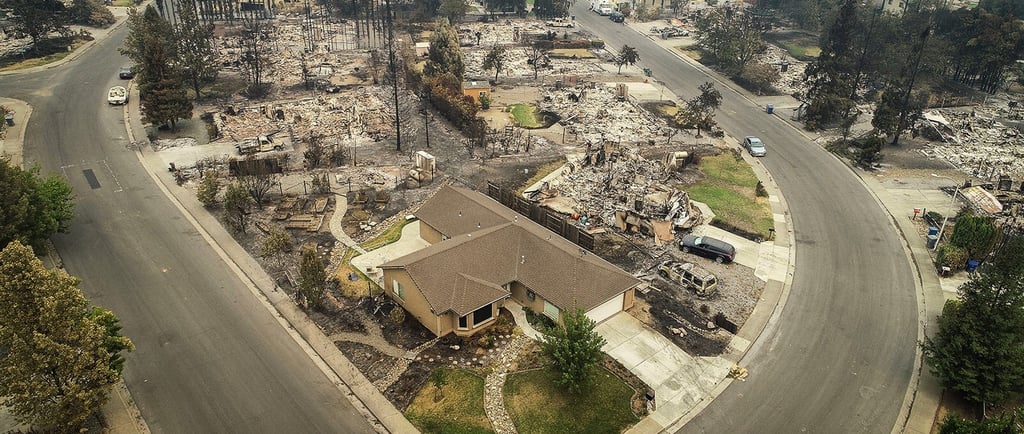
The public often thinks homes burn in wildfires because the wildfire itself directly engulfs every house. But that is not usually what happens in the most destructive wildland urban interface (WUI) fires.
What often happens is that the homes on the edge of the WUI catch fire first. Those homes ignite from direct flame contact, radiant heat, or embers coming from the vegetation fire nearby. But after those first homes ignite, the wildfire changes character. It becomes a structure-to-structure urban fire spread event.
In many suburban housing developments, the homes are built close enough together that they effectively act like dominoes lined up side by side. Once one home catches fire, the next home is exposed to intense radiant heat, direct flames, and showers of embers. Then that home ignites. Then the next. And then the next.
But unlike falling dominoes, wildfire spread between homes is even worse because embers can travel far ahead of the fire. Burning homes generate massive ember storms that can travel several yards, hundreds of yards, or even thousands of yards depending on wind conditions. Those embers can ignite homes far away from the original wildfire front.
The good news is that all is not lost. There are ways to interrupt this chain reaction and prevent structure-to-structure wildfire spread.
One of the biggest causes of home ignition is ember intrusion. Embers can enter homes through attic vents, eave vents, crawl space vents, and basement vents. Once inside, embers can ignite dry combustible materials where the fire may go unnoticed until the structure is already heavily involved.
Installing ember-resistant vent screens over or behind existing vents can significantly reduce the chance of ember intrusion.
Another major defense is creating a completely non-combustible zone immediately around the structure. If embers land next to combustible mulch, dry vegetation, wooden fencing, patio furniture, or debris, they can ignite small spot fires that eventually spread to the structure itself. But if the immediate perimeter around the home is non-combustible, many ember ignitions simply fail.
Good defensible space also plays a major role. Reducing fuels around the structure lowers flame intensity and decreases the probability that nearby vegetation ignites the home.
And in some situations, active fire defense can prevent structure ignition as well. A properly prepared fire defense unit consisting of a portable fire pump, independent water tank, hoses, and fire retardant gel can allow homeowners to extinguish spot fires and ember ignitions before they grow into uncontrollable structure fires.
The important point is this: catastrophic WUI fire spread is not inevitable. Homes do not have to burn simply because a wildfire enters a community. Structure ignition often depends on specific vulnerabilities that can be mitigated or eliminated.
When homes are hardened against ember intrusion, surrounded by non-combustible space, and properly defended, the domino effect of suburban wildfire spread can be slowed, interrupted, or stopped altogether.
Contacts
(520) 988-0759
info@fire-prousa.com
Contact Page
Emergency Service Hours
24X7, 365 days per year